
Dr Brad Hine
BUILDING resilience into feeder cattle is one of the components that can help deliver greater efficiency, productivity and profitability in grainfed systems, beef producers attending last week’s Feeder Steer MasterClass held in Ballarat heard.
Angus Australia’s extension leader Dr Brad Hine, an animal health and genetics specialist who worked with CSIRO earlier in his career, posed the question: Why would we talk about resilience when discussing feeder steer performance?
He defined resilience in this context as the animal that has the ability to thrive in a variable production environment, while remaining productive.
Dr Hine likened sending feeder steers to the feedlot as being like “sending your kids to day care for the first time.”
“All feedlots work hard to minimise stress on animals at entry, but there are some things that we just can’t avoid. Some of the challenges include changes to diet, handling and transport stressors, being confined, pathogens and social disruption when mixed with strangers – a really important one.
Animals respond to these challenges via a series of what’s called host/defence responses, which can be physiological, immunological or behavioural in nature.
“These defence mechanisms are all closely integrated with each other,” Dr Hine said, “and together they define an animal’s resistance – their ability to cope with those challenges and remain productive in the feedlot environment – and it’s all about reaching their genetic potential.”
Phenotype = genetics + environment
Dr Hine reminded the gathering that the phenotype of what is seen in a feeder steer is the result of genetics plus environment.
So what can breeders do on-farm, from a breeding perspective, and how can they combine those with best management practises to lead to the best phenotypes at the feedlot?
He said breeders tended to focus on key traits when producing feeder cattle, like:
- 400-600 day growth
- Feed efficiency
- Various carcase traits for meat quality and yield.
However it was also important to think about ‘resilience’ traits, Dr Hine said.
He warned that by selecting cattle ‘very hard’ for productivity traits, without considering resilience traits, there would be consequences.
Under the term, resilience traits, he highlighted three topics:
ImmuneDEX
ImmuneDEX is an Angus index used to estimate the genetic capacity of cattle for overall immune competence. It combines both cell-mediated and antibody-mediated immune responses to predict an animal’s ability to resist diseases without hindering growth or fertility.
“It is designed to help identify animals with improved general disease resistance,” Dr Hine said.
“When we set out to develop a trait around general disease resistance, we understood that in our production systems, we see spikes in disease incidence that accompany those stressful times in an animal’s production life. What we aimed to do was predict the ability of animals to cope with a disease challenge when under stress.”
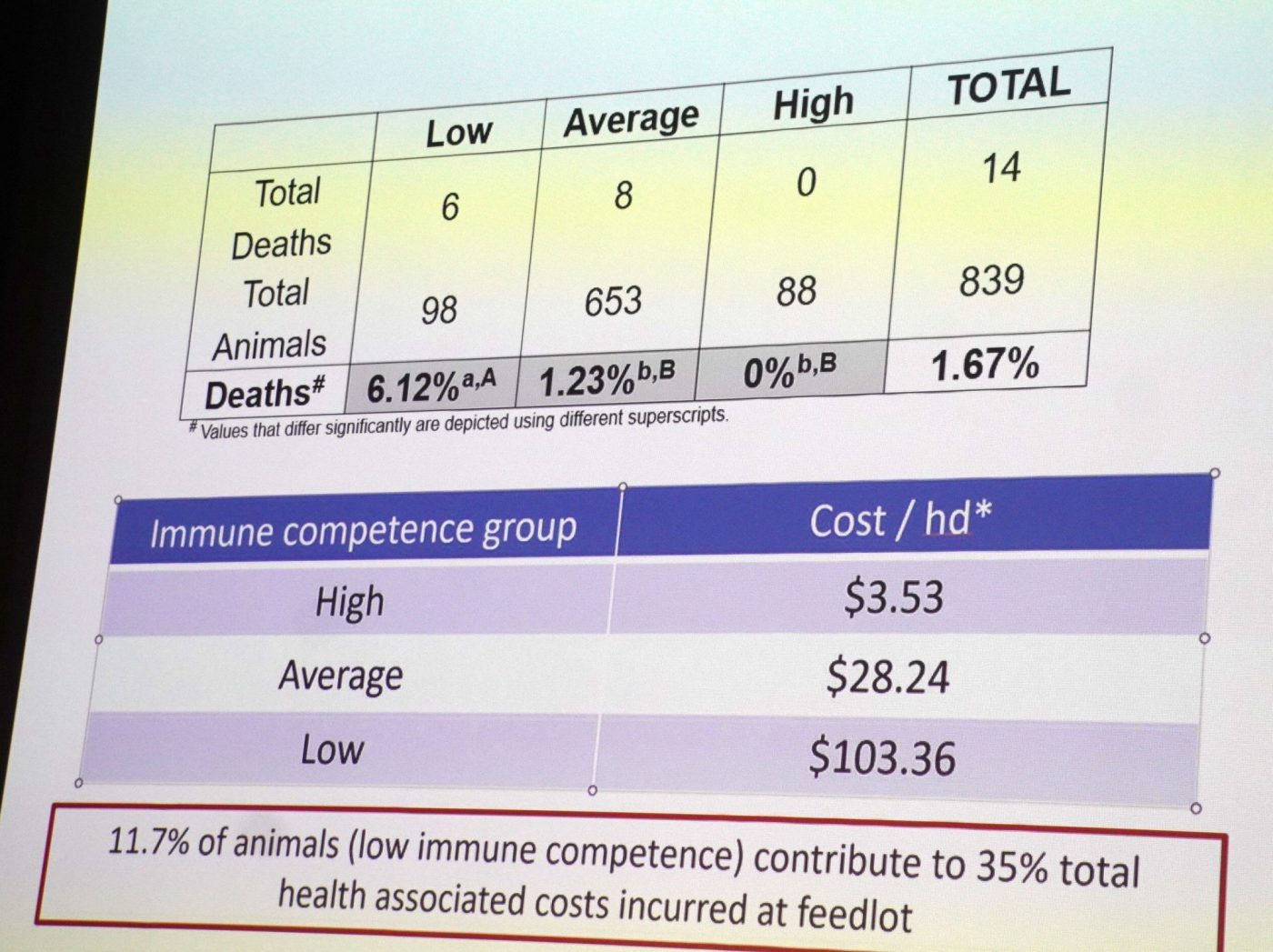
A series of ImmunDEX trials looked at immune competence in 839 tested animals, following through their performance in the feedlot environment to see how well that phenotype predicted their performance, in terms of respiratory health. The group of animals was immune competence tested at weaning, and followed through at feedlot finishing, characterised into three groups as low immune competent, average or high. Data was collected on their health at the feedlot, with a cost calculated based on mortality or morbidity (sickness, leading to poor ADG), plus the cost of drugs and intervention.
Click on image for a larger view
Among the high immune competence group, the average cost to the feedlot was just $3.53/head; the average group’s cost was $28.24; and the low group, a whopping $103.36 (mortality was above 6pc).
“The take home was that while there was only a small number of animals identified using ImmuneDEX as low immune competent, they contributed to a significant portion of the health costs at the feedlot,” Dr Hine said.
Development work continues on the ImmuneDEX trait, and it is hoped that an extended model called ImmuneDEX+ will cover both respiratory disease, as well as pinkeye resistance.
Docility
Docility has a lot more to do with resilience than what many expect, Dr Hine said.
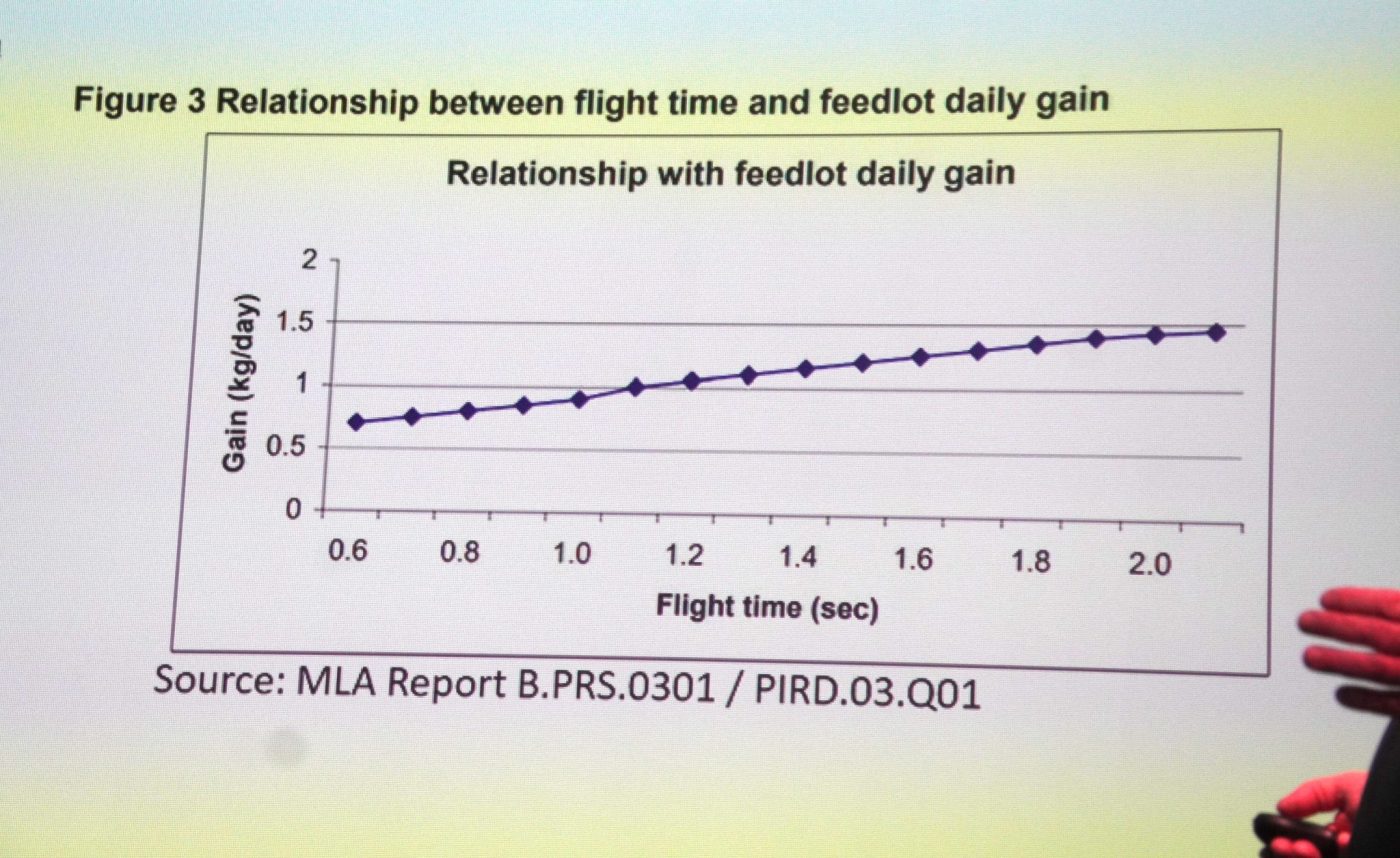
In the Angus world, an EBV for docility has been developed based on crush or yard test scoring, observing their behaviour around human interaction. Other tests used in the development of the ImmuneDEX trait included animal flight speed testing from the crush, to measure temperament. Short flight time from the crush means the animal was agitated while in the crush.
An early Beef CRC study on the influence of temperament on feedlot performance produced the following result, showing flight speed time was strongly correlated to feedlot ADG performance.
Coat type
The trait of coat type is currently a Research EBV at Angus Australia.
What does it have to do resilience?
“There’s a lot of research to support the view that slicker-coated Angus are more heat-tolerant, and it (coat score) is a topic of considerable interest among the Queensland Angus group, for people taking Angus genetics into the north,” Dr Hine said.
“Why is that important for feeder steer producers? If your steers are going into northern (ie Southern Queensland) feedlot environments, coat score is potentially a trait you should be concentrating on.”
Conversely, feedlots in southern Australia were interested in coat-type, because of the greater risk of dags on heavy-coated cattle, especially during cold, wet winters when feedlot surfaces don’t dry out.
Yards weaning, pre-vax
Dr Hine also stressed the significant respiratory performance difference in the feedlot between yards weaned/trained weaners and those paddock weaned. He also touched on pre-vaccination for respiratory disease and the growing expectation among lotfeeders that cattle are treated prior to entry.
“Why feedlot operators like you to pre-vaccinate animals at home, is because if you do that in a low-stress environment, those animals will respond significantly better to the vaccine – and protection takes time to take effect. The killed vaccines take at least a couple of weeks after delivery before they protect animals,” he said.
However he stressed it was important to vaccinate prior to weaning, so calves are protected when going through the stress associated with the weaning process.
One study showed yards-weaned, pre-vaccinated feeders grew 60pc faster in the first month on feed, on average.
Questions
There was a bunch of topics directed to Dr Hine during questiontime.
 One masterclass member asked whether there was a difference between genetically-influenced docility, and docility that could the ‘trained into’ feeder cattle, and whether it transferred across breeds.
Dr Hine said flight speed testing carried out at the start of weaning would often produce animals that were ‘a bit agitated,’ going through the crush for the first time.
“To me, the animals we want are those that acclimate to handling. They may not be perfect the first time they go through the crush, but at the end of the weaning period is a really good time to look at things like flight speed and crush score.
Bos Indicus question
He said the Bos Indicus question around immune competence was an interesting one.
“As an immunologist, it is counter-intuitive that animals can be brought from a very extensive environment, and put in an intensive environment, and they perform better, health-wise.”
“That is very much the case – there is a mountain of evidence that Indicus cattle, healthwise in the feedlot, are better than Taurus cattle. We see that all the time – it’s a fascinating question, but I can’t answer why that is. It does not make sense from an immunological perspective, because they have had less exposure to pathogens before they get there.
“The same question has been asked for 20 years, but it’s one we’ve never been able to answer.”
“But what is very clear from immune competence testing as part of the multi-breed project, is that the variation within breeds is much bigger than between breeds.”
Another participant asked about selection for slick coat, and whether (in the south) this risked breeding cattle that would struggle to handle cold conditions.
“It’s very much the northern industry chasing that slick coat in Angus cattle,” Dr Hine said.
“But you’re 100pc right: how that impacts performance in southern animals in winter needs scrutiny. The coat score research EBV for Angus needs to do more research on how selection for coat score influences genetic progress for other traits.
“As we get more and more coat-score phenotypes into the system, we start to look at those genetic correlations between coat score and other traits. For me, I’d love to get to the point where we have a resilience index for the north, and then a very different resilience index for the south.”
“Having tailored indexes for the environments those feeder animals are going into is a really important objective to work towards.”
HAVE YOUR SAY