
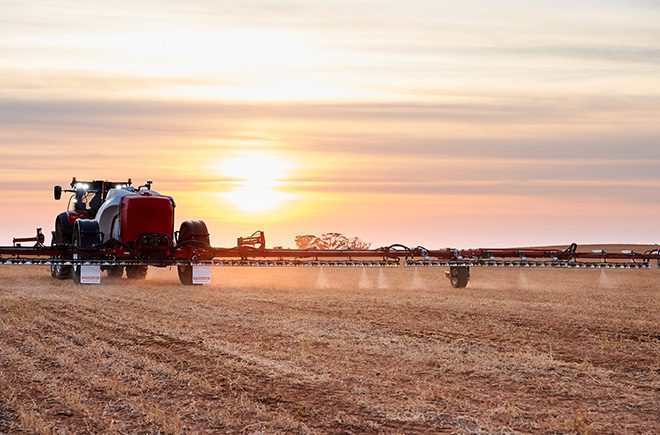
Under new APVMA regulations, maximum application rates of paraquat have been lowered but it can still be used to spot spray weeds in fallow. Photo: Croplands
THE Australian Pesticides and Veterinary Medicines Authority has today delivered its long-awaited decision on the use of paraquat and diquat.
They have not been banned, as many in the broadacre sector feared.
The knockdown herbicides jointly play an important role in controlling weeds in fallow, and in pre-harvest weed control and crop desiccation.
As detailed in the APVMA Special Gazette released today, the phasing in of stricter controls will reduce their maximum rate and require enclosed mixing and loading systems for all uses, and phase out their application from backpack sprayers.
“Both chemicals remain available for use with significant new restrictions on application rates and permitted uses,” APVMA chief executive officer Scott Hansen said in an APVMA statement.
 “To protect users from acute exposure, new restrictions will phase out backpack sprayers and require enclosed mixing and loading systems for all uses, and enhanced personal protection equipment,” Mr Hansen said.
“Overall, the maximum rate of application on paraquat and diquat will be 231grams per hectare, when it was previously 1150g/ha.”
A higher application rate applies to technology-assisted spot spraying where application is capped at 30 percent of total area.
New registration conditions will apply to the labels of all paraquat and diquat products manufactured from today.
Existing stock will be phased out over a two-year period, allowing the industry to identify and adopt alternative weed management strategies, and prepare for the implementation of new occupational health and safety measures.
Response to toxicity risks
The APVMA said these restrictions are driven by acute toxicity risks for people handling the Schedule 7 poisons and a detailed assessment of data showing acute and chronic exposure risks to birds and mammals foraging in treated areas.
During the review process, the APVMA received 171 submissions from scientists, doctors, the agricultural industry and other interested parties.
Submissions on paraquat and diquat included a range of concerns including human health impact, farming viability and environmental impact.
The APVMA considered submissions which provided detailed scientific information or argument in line with contemporary international data requirements and test guidelines.
In making its decision, the APVMA found the weight of evidence does not show that paraquat exposure through approved uses increases the risk of developing Parkinson’s disease.
Welcomed by GPA
Grain Producers Australia has welcomed the outcome of the review, which confirms paraquat and diquat will remain available for use in Australian broadacre farming systems subject to revised use conditions and label requirements.
Victorian grower and GPA research development and extension spokesperson Andrew Weidemann said the decision ensures grain producers have ongoing access to two critical weed-management tools that underpin minimum and no-till farming systems across Australia’s grain-growing regions.
“These farming systems have driven significant productivity gains over recent decades while reducing soil erosion, improving moisture retention, lowering fuel use and supporting more sustainable grain production,” Mr Weidemann said.
Paraquat will continue to be available for use through optical spot-spraying technologies and also continues to allow the practice of crop-topping for pulse growers, with an increase from seven to 14 days applying to the withholding period.
Mr Weidemann said the decision demonstrated the value of Australia’s independent agricultural chemical regulatory system and the strength of collaboration across the grains industry to produce a logical and science-based submission to the process.
“Australia is fortunate to have an independent, evidence-based agricultural chemical regulatory agency in the APVMA.”
Mr Weidemann said GPA had invested significant effort throughout the review process because of the importance of paraquat and diquat to modern grain-production systems.
GPA said it looked forward to continuing to work with the Grains Research and Development Corporation researcher Chris Lee-Steere and other industry stakeholders to review the full detail of these decisions.
“Our work started some four years ago when GPA engaged Applebox Insights founding director Peter Arkle to identify upcoming chemical reviews and prepare industry for these challenges, and we want to acknowledge his contribution.”
“GPA prepared a comprehensive submission in response to the APVMA’s preliminary review decisions and we will take the time to review the rationale behind today’s final determination.
“This is a positive outcome for Australian grain producers and the ability to maintain minimum and no-till farming systems is one of the great success stories of Australian agriculture.
“These systems have delivered enormous productivity gains while helping growers protect their soils, conserve moisture and reduce the environmental footprint of grain production.”
Sources: APVMA, GPA
HAVE YOUR SAY