
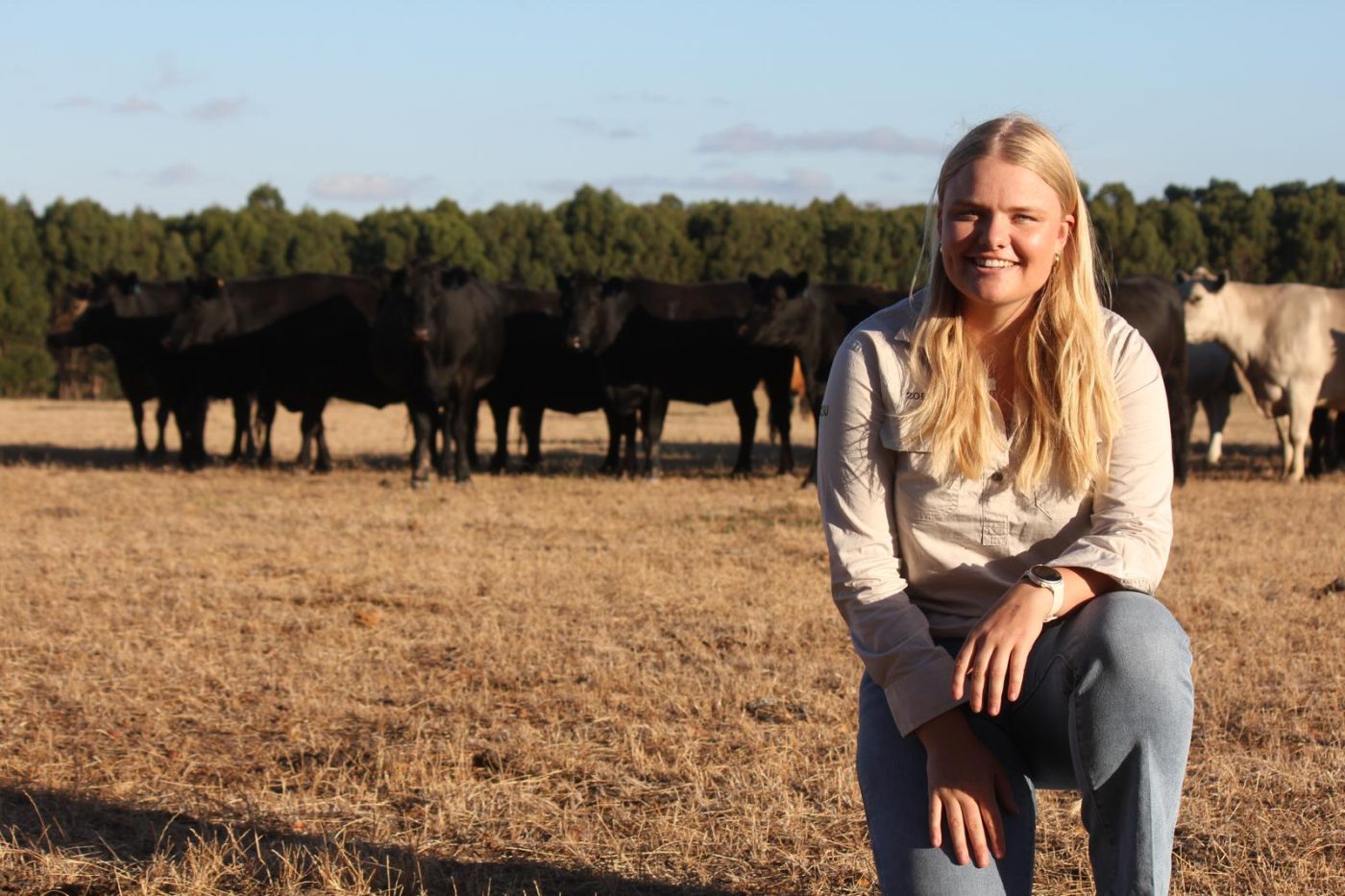
An Australian meat judging team member says the US beef-on-dairy crossbreeding experience could become a blueprint for Australian producers.
Zoe Skinner toured the United States’s meat industry earlier this year as one of five members of the Australian Intercollegiate Meat Judging (ICMJ) team and says beef-on-dairy crossbreeding has formed a critical part of the country’s response to a declining national herd.
“What was once discounted as a long, poorly-muscled byproduct of the milk industry is now commanding a premium of several hundred dollars per head at the drop, thanks to targeted beef-on-dairy semen sales which hit 9.4 million units recently,” Ms Skinner said.
In her report, titled Why beef on Dairy? Growth and implications of Beef-on-Dairy crossbreeding the US cattle sector, Ms Skinner said US beef-on-dairy crossbred calves have skyrocketed from a niche 50,000 head in 2014 to a staggering 3.22 million in 2024.
“With projections firmly set on reaching six million head this year, dairy-origin cattle now make up more than 20 percent of the total US beef supply,” Ms Skinner said.
Back home, Ms Skinner said the commercial wheels are already turning with Dairy Australia’s Calfways initiative, which has set an ambitious target to integrate 300,000 to 400,000 additional non-replacement dairy calves annually into the beef supply chain by 2035.
The program aims to boost national processing volumes by seven per cent while simultaneously addressing a key social license issue: eliminating the on-farm euthanasia of healthy dairy bull calves.
Ms Skinner said her research found early pilot trials across northern Victoria and Tasmania are yielding impressive results.
Using Angus and Wagyu genetics on dairy cows, the trials recorded average daily gains of 1.3kg to 1.9kg over 90 days on feed. Crucially for quality-driven markets, the crossbred cattle achieved marbling scores up to eight and nine – outcomes directly competitive with traditional beef breeds.
 “Innovative producers, such as the Gardiner family in northern Victoria and Kevin Jones in South Gippsland are leading the charge, proving that strict colostrum protocols and targeted nutrition can deliver the consistent lines of uniform cattle that processors crave,” Ms Skinner said.
In an era hyper-focused on ESG credentials, dairy-beef crossbreds also hold a unique environmental advantage. Because a substantial portion of the animal’s lifetime carbon emissions are attributed to milk production, the final beef product boasts a significantly lower embedded carbon footprint per kilogram.
However, Ms Skinner said the US industry experience should serve as both a green light and a warning sign to Australian producers.
“US processors report a significantly higher incidence of severe liver abscesses in beef-on-dairy cattle compared to conventional beef animals,” she said.
“Fed on aggressive, long-term, high-energy grain rations, the cattle experience gastrointestinal stress, allowing bacteria to migrate to the liver.
“At the processing plant, this leads to liver condemnations, carcass trimming, and costly chain slowdowns, a hurdle Australian lot-feeders will need to manage through higher-fibre rations and less aggressive stepping programs.”
Ms Skinner’s report identified other hurdles for the Australian industry, too.
“Unlike the US system of year-round calving, Australia’s dairy industry is highly seasonal and pasture-based, leading to massive gluts of calves over short periods,” she said.
The report identified that historical pricing grids have offered limited financial incentives for dairy-origin cattle for Australian producers.
However, with Meat & Livestock Australia’s Strategic Plan 2030 focusing heavily on value-based marketing, the introduction of objective measurement technologies like DEXA and MEQ scanners may allow processors to reward high-marbling dairy-beef options fairly.
Ms Skinner said her ICMJ experience in the US clearly demonstrated to her that the dividing line between the beef and dairy industries is blurring, and those who invest early in trusted supply chain partnerships have a better chance of capturing a wave of highly consistent, sustainable, and profitable red meat.
Ms Skinner earned her place in the Australian ICMJ team after participating in the 2025 ICMJ National Conference and Competition in Wagga Wagga and progressing through a number of selection stages.
The 2026 ICMJ National Conference will be held next week (Tuesday 30 June to Saturday 4 July), attracting participants from around Australia, as well as teams from the United States and Japan.
The Australian ICMJ program is supported by foundational partners, Meat & Livestock Australia and Australian Meat Processor Corporation as well as a range of industry sponsors.
Source: ICMJ