The floods of the past two years have taken a lot from Queensland cattle producers. For stud and commercial operations alike, the hardest loss wasn’t always infrastructure. It was the animals that couldn’t be replaced. The cows with the fertility and temperament you’d spent years selecting for. The bulls that couldn’t be re-bought because nothing else in the market matched them.
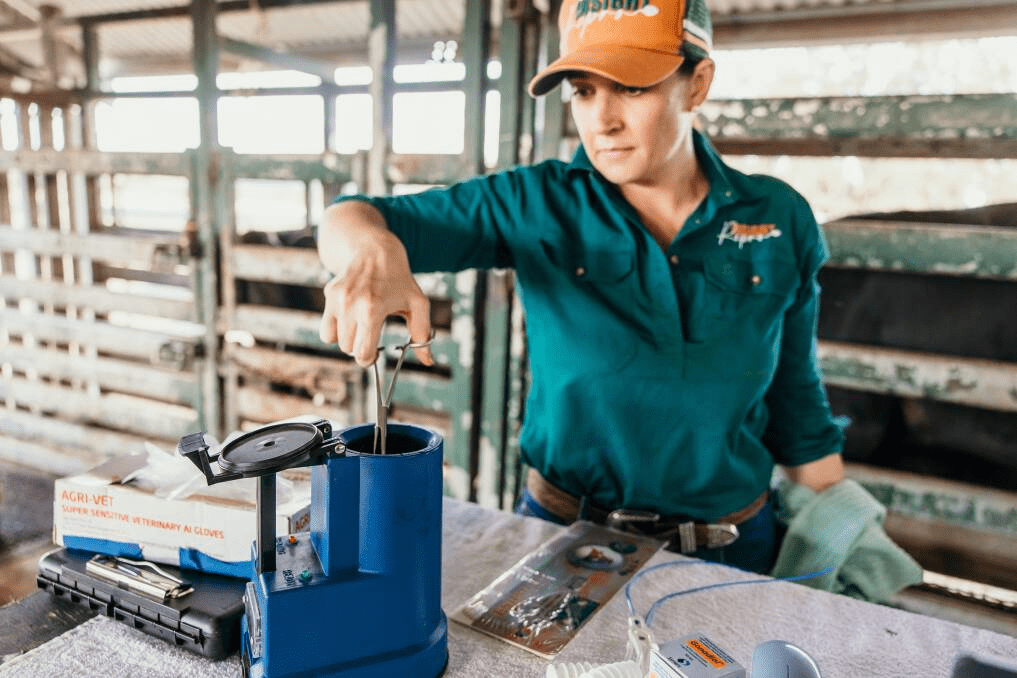
Jane Armstrong Insight Repro, Emerald QLD
I’ve spent years working with producers in Central and Western Queensland on bovine reproductive technology, and one of the most frustrating conversations I have is the one that happens after a disaster. “We lost three of our best donors in the flood.” “We had to sell the cows we couldn’t feed and now we’re starting again.” It happens to stud breeders and it happens to commercial operators. The genetics are gone. The years of progress are gone with them.
That’s why I lobbied the Queensland Government to include embryo transfer as an eligible cost under the Primary Producer Disaster Recovery Grants. I’m pleased to say those efforts, alongside advocacy from others across the industry, have been successful. As of April 2026, embryo transfer procedures are now eligible for reimbursement under grants of up to $75,000, retrospectively applied to disaster events from January 2025 onwards.
But the grant is only useful if you have embryos to transfer. And that means the conversation we need to have right now is about genome banking, before the next event, not after it.
What genome banking actually means
Genome banking is simple in concept: collect and store the genetic material from your best animals so that it exists independently of the animal itself. For cattle producers, stud and commercial alike, that means semen collection from your best bulls. For those ready to take the next step, it means embryo collection from your elite donor cows via *in vitro* fertilisation (IVF) or embryo transfer (ET).
Think of it as an insurance policy for your breeding programme. If your best bull is lost in a flood, hit by a truck, or dies unexpectedly, his genetics don’t have to go with him. If your top donor cow is swept away in a monsoon, her embryos can still be in a tank somewhere, ready to go.
The window to act is right now. We’re heading into cooler weather, which is the ideal time to collect and bank semen from your bulls. OPU season, when we collect oocytes from donor cows for IVF, opens in July. If you want embryos in the tank before the summer breeding season kicks off in November, you need to be planning that work in the next eight weeks.
Understanding the cost: what you’re actually buying
One of the reasons producers hesitate on IVF is the per-procedure cost. It’s higher than AI, and that’s a fair observation. But the comparison changes when you look at it as a cost per calf on the ground, and more importantly, as a cost per year of genetic gain.
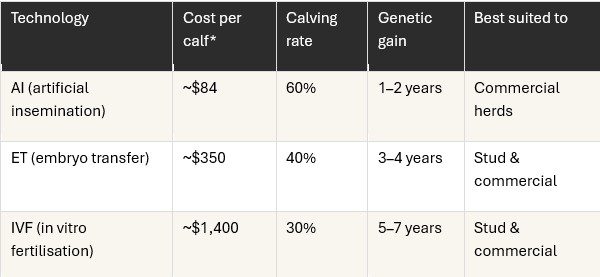
*Costs exclude semen and travel. Based on industry average calving rates.
AI gets you one to two years of genetic advancement per calf. IVF gets you five to seven. For a stud operation compressing a decade of genetic improvement into a five-year recovery plan, that difference is transformational. For a commercial operation, the gains are just as real. The difference is in what you’re selecting for: drought tolerance, feed efficiency, fertility, and the kind of resilience that means your herd performs in the years ahead, not just this season.
IVF also does something neither AI nor ET can: it multiplies genetics from both the dam and the sire simultaneously. For commercial producers, that means selecting not just for the best bull available, but for the best female lines in your herd, locking in the traits that actually drive profitability at your gate. Heavier weaners. Tighter calving windows. Better feed conversion. Those are commercial outcomes, and IVF is how you accelerate them.
What the grant covers
For producers directly impacted by an eligible disaster event, the following costs are now reimbursable under the Disaster Recovery Grants:
-
Synchronisation drugs for recipient cows
-
Veterinary procedure fees for implantation
-
Labour and technician costs associated with embryo transfer
-
Travel costs required to access remote properties
Producers can claim costs for using their own stored embryos that were cryopreserved prior to the disaster, or for donated embryos from industry partners. The grant covers the implantation costs.
Eligible events include the Queensland Monsoon Trough, Cyclone Koji, Cyclone Narelle, and associated severe weather from late 2025, as well as the Western Queensland Surface Trough and the North and Far North Tropical Low from 2025. Eligible LGAs stretch from the Far North to the south-west, through Gulf Country, down the coast to Gympie, and through the Wide Bay-Burnett into the central interior.
Grants of up to $75,000 are available through the Queensland Rural and Industry Development Authority (QRIDA) at qrida.qld.gov.au.
The shift from relief to resilience
What I find most significant about this policy change is what it signals. Both the Australian and Queensland Governments are now formally recognising embryo technology as a legitimate tool for disaster mitigation and recovery. That’s not a small thing. It means the conversation has shifted from “what do we do after the flood” to “how do we prepare before it.”
That’s the conversation I want to have with producers, stud and commercial. Not just how to use the grant, but how to think differently about your breeding programme as a resilience asset, something you build and protect, not just something you rebuild.
The genetics in your herd represent years of work and real money. The technology now exists to protect them. The government is now prepared to help fund the recovery when the worst happens. The only question is whether you’ve got anything in the tank when you need it.
Insight Repro is based in Emerald and services Central and Western Queensland. insightrepro.com.au
HAVE YOUR SAY