
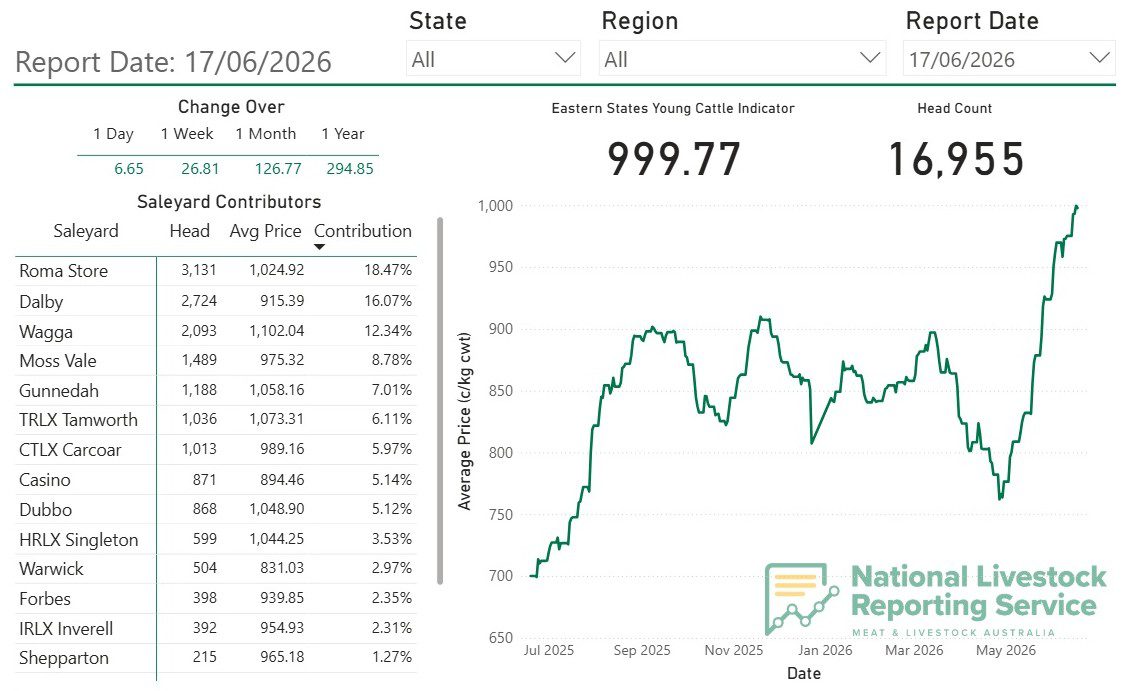
THE Eastern Young Cattle Indicator cracked 1000c/kg (dressed weight equivalent) briefly yesterday, hitting its highest level since 2022.
The EYCI is a live indicator, meaning it can vary throughout the day, as sale results are added. It lifted above 1000c/kg briefly yesterday, before closing the day at 999.77c/kg, on rolling weekly throughput of just short of 17,000 head of eligible cattle.*
The last time the indicator sat above 1000c was 15 November 2022, as the national herd was focussed on herd rebuild after the 2019-20 drought, and young cattle became extremely scarce. The EYCI reached its all-time record high of 1190c in January 2022.
The big difference with the current surge is that cattle supply is much more abundant than during the record price period four years ago.
Yesterday’s closing EYCI price of 999.77c was up 27c on the same time last week; 127c higher over the past month, and 295c up on the same time last year.
The average price difference between EYCI-eligible yearling steers and heifers yesterday was exactly a dollar – 1038c/kg versus 938c.
Eight selling centres over the past week recorded EYCI-eligible cattle averaging above 1000c: Roma, Wagga, Gunnedah, Tamworth, Dubbo, Singleton, Wodonga and Scone. Yesterday’s Dalby sale in Queensland dragged the average back a little, averaging 915c for EYCI-eligible stock.
Restockers driving market
While both restocker and feedlot buyers bought young cattle at average prices above 1000c/kg (dw) over the past week, restockers are clearly driving the ship, purchasing close to 10,000 head over the past week, at prices up 12c/kg on the previous week.
Lotfeeders accounted for 6500 head over the past seven days, averaging 45c/kg (DW) higher than the week before.
 Other young cattle indicators (all measured in liveweight) have shown similar trends, with the national feeder steer indicator lifting another 21c/kg over the past week to 527c/kg yesterday, up 47c since rain impact started a month ago. Back in late April at the bottom of the cycle, the feeder steer indicator was at 436c.
Since late April, restocker yearling steers have lifted close to 100¢/kg, while feeder steers have gained more than 70¢/kg.
Over the same period restocker yearling steers maintained a premium over feeder steers as grass and grain buyers competed for the same cattle. Competition is strongest across the 280–400kg range, with Queensland providing volume and NSW driving much of the price strength.
Restockers continue to drive the overall young cattle market due to strong competition between backgrounders and feedlots, with both buyer groups competing for a tighter supply of young cattle, MLA market information analyst Emiliano Diaz said. .
Current price trends mark a clear shift from April, when dry conditions and larger offerings weighed on restocker confidence.
“The market has moved from a feeder-led base to a more competitive environment where grass and grain buyers are bidding into the same steer pool,” Mr Diaz said.
“Lotfeeder demand remains firm, supported by ongoing grainfed turnoff requirements, but the return of restocker demand has accelerated the price recovery.”
Weight range competition
The weight profile shows where competition for young cattle is strongest. Feeder demand remains concentrated in heavier lines, particularly 330–400kg and +400kg cattle. These weights accounted for most feeder steer throughput this week, confirming that lotfeeders are still focused on cattle that can move efficiently into grain programs.
However, the lift in lighter feeder categories suggested buyers are reaching further down the weight range where supply is tight, Mr Diaz said. The 280–330kg feeder segment recorded one of the strongest weekly price movements, albeit off a smaller offering. This points to feedlot buyers competing more actively for cattle that would otherwise have attracted restocker interest.
Restocker demand over the past week was more evenly spread across 200–400kg cattle, with the strongest volume in the 200–280kg range. The 330–400kg restocker category also held firm, trading at the highest average price across the restocker weight ranges.
“This demonstrates that restockers are not only chasing lighter cattle to put back on grass but are also prepared to compete for heavier yearlings with more production flexibility,” Mr Diaz said.
“The overlap is most evident in the 280–400kg range. These cattle can suit either pathway depending on frame, condition, feed availability and buyer margins. Restocker values holding above feeder values suggest backgrounders are currently prepared to outbid feedlots for the right animal.”
Queensland supplies the numbers, while NSW drives price momentum
Queensland continued to provide the volume base in young cattle supply, particularly through Roma, Blackall, Dalby and Gracemere. In the restocker yearling steer market, Roma was the dominant contributor this week, accounting for more than one-third of throughput and trading above the national average.
Blackall also supported the indicator, with prices lifting despite a smaller yarding.
The restocker indicator was supported by stronger results through Roma and Blackall, alongside high-priced lines at Wagga.
For feeder steers, Queensland supplied depth, but NSW provided much of the price strength. Blackall, Dalby and Roma were the largest volume contributors, while Wagga, Carcoar, Gunnedah and Tamworth all traded well above the national average.
Gunnedah and Carcoar recorded some of the strongest week-on-week price improvements, while Wagga added both volume and price support.
* About the EYCI
The Eastern Young Cattle Indicator (EYCI) is the general benchmark of Australian cattle prices. The indicator is a seven-day rolling average produced daily by MLA’s National Livestock Reporting Service. The EYCI includes vealer and yearling heifers and steers, grade score C2 or C3, 200kg+ liveweight from saleyards in NSW, QLD and VIC. The results include cattle purchased for slaughter, restocking or lotfeeding and are expressed in c/kg dressed weight.