
Angus cattle
IMPORTANT changes are happening in less than a fortnight, in the way Australian beef carrying breed-based brand claims can be described and marketed.
From 1 July, a new set of rules devised by the AusMeat Language and Standards Committee will apply to all branded beef breed raising claims.
Because of the long lead-times in beef production, product being put into cartons during June has already started to include the new description requirements.
As described in this earlier item on Beef Central, the breed content raising claim and description issue has been one of the most divisive to pass through the industry’s Language and Standards Committee in recent memory.
While 50pc breed content has been the minimum standard for an Angus raising claim in the United States and elsewhere, Australia has up to this point had a 75pc content requirement to claim an Angus identity. That changes next month, with the introduction of an option for 50pc Angus claims.
Australia’s current 75pc minimum standard is linked to the launch of McDonald’s Australian Angus burger range back in 2007 (see today’s separate story), which was built around a Certified Australian Angus Beef (CAAB) regulation requiring 75pc content or better. Australia’s 75pc Angus content ‘standard’ for a breed claim evolved from there.
Critics claim that Australia’s 75pc minimum standard has placed our industry at a competitive disadvantage against other exporters, with adoption of a 50pc minimum content option, allowing Australian exporters to align with the US industry.
Those in favour of a minimum 75pc program claimed that it ‘set the bar a little higher’, underscoring consistency of meat quality in Australian Angus brand programs against competitors. Any change would confuse international and domestic customers.
At the same time, Australia’s 75pc ‘standard’ on Angus did not apply to other breeds. Wagyu brand programs that started to emerge in Australia in the mid 2000s evolved separately, with 50pc (F1) brand programs being a fixture from day one.
New rules
The final decision reached earlier this year has created an opportunity for 50pc Angus content programs to be established – but only under specific naming rules.
For those interested in the detail of the new terms that apply from 1 July, the changes to breed claim criteria and trade descriptions can be read here. A specific Angus fact sheet about the regulations can be read here.
 So why is all this important? Statistics produced by AusMeat show that the word ‘Angus’ dominates the approved Animal Raising Claims list used by brand managers.
There are 62 approved animal raising claim programs in Australia (both domestic and export) based on Angus. The next largest group is ‘Grassfed’ programs with 42 brands, followed by Wagyu with 27, HGP-free with 25 and Never Ever programs, 25.
While much of the attention during the pre-implementation phase has focussed on Angus programs, the new regulations apply to all beef breeds, and multi-species,
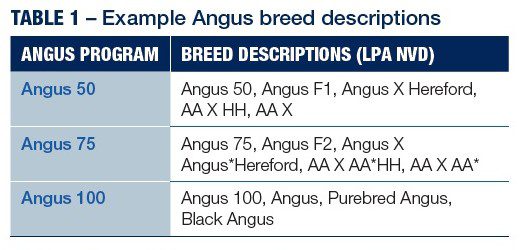
Using Angus as an example in the approaching regulation changes from July, there are three approved categories for Angus parentage claims, each defined by a minimum breed content threshold:
- Angus 50 (F1) – at least 50pc Angus parentage
- Angus 75 (F2) – at least 75pc Angus parentage
- Angus 100 (Pure Angus) –100pc Angus parentage
Eligible breed descriptions for each are set out in these tables:
(table Breed Full explanations of each are available here ( )
For plants operating under AusMeat standards, the rules are the same regardless of whether the product is destined for export or domestic use. In many cases, product ends up in both.
What does this mean for producers?
Accurate breed identification and documentation remain critical when completing the National Vendor Declaration (NVD), AusMeat says.
“With the introduction of the Angus 50 program, producers must now pay closer attention to recording parentage details to ensure cattle meet the eligibility criteria for branded beef programs, and in turn, maximise the value proposition of beef from the farm gate to market,” it says in an advisory note.
Maintaining accurate breed records is essential for regulatory compliance, market access and supporting the continued strength of Angus-branded programs both domestically and internationally.
The current set of requirements set out in the attached documents are not set in stone, however. Discussions continue about the role that DNA verification may play in breed content verification at some future time – beyond voluntary customer-driven DNA testing. However drawbacks are seen in using DNA for verification, include cost and delays in turnaround from sample extraction to delivery of results.
AusMeat’s general manager for meat standards and training services, Ben Robinson, told Beef Central that any processor or exporter who wanted to put together an ‘Angus 50’ program under the new regulations needed to get the proposed program approved by AusMeat first.
“A small number of such programs have already been approved, and others have been submitted,” he said.
“The new standards set a minimum genetic content criteria of 50pc for any breed claim that might be made – be that for sheep, goats or cattle. All the other factors beyond that are breed-specific (a phenotypic characteristic than needed to be assessed, for example), meaning they involve working with the relevant breed society to determine what the criteria is to determine that characteristic.”
“We won’t move forward until breed societies support whatever the pathway is that’s been chosen. Angus is a good example: AusMeat worked with Angus Australia to determine characteristics, using Angus’s own definition of what a 50pc looks like,” he said.
Several breeds make brand claims
Currently across the industry, breed claims are made (via AusMeat) across Wagyu, Shorthorn and Angus, and at different times in the past, Hereford, Santa Gertrudis and Holstein. Interest has also been shown from two separate processors to develop lamb breed claims, Mr Robinson said.
“We now have the ability to cut and paste the new framework, including technical content relevant to the breed, as industry sees fit,” he said.
Using a typical ‘Angus 50’ program as an example, Mr Robinson said once a submitted program is AusMeat approved, the processor involved would then develop a livestock supply program designed to validate and verify each animal as being at least 50pc Angus content, against an agreed set of criteria.
“That’s relatively easy when it is vendor-bred animals, but it becomes more challenging for non-vendor-bred – because it relies on the flow of documentation,” he said.
“In effect, what a farm program needs to be able to demonstrate is that an animal being put on a truck to send to a meatworks or feedlot meets the minimum 50pc standard.”
For non vendor-bred or saleyards cattle, documentation is needed to support the case. The documentation that is created is up to each supply chain’s program – AusMeat does not prescribe that. However the documentation (either added part of the NVD, or a separate company declaration) must be able to verify that the cattle are indeed 50pc Angus or higher.”
AusMeat’s role was to approve the on-farm program that the processor submits; the livestock sourcing program that the processor puts in place; and thirdly, the traceability program to be able to maintain segregation of live animals, through to carcases and meat, into the box, in the processing plant.
Exactly the same requirements would apply for an ‘Angus 50’ trimmings program, as an Angus 50 chilled loin cuts program, he said.
Distinguishing breed content from quality
Mr Robinson made the point that the AusMeat breed content claims should not be confused with quality claims.
“Separate quality out of the conversation completely,” was his advice. “This is about verifying what a 50pc Angus is – quality will then be determined by the brand owner themselves, whether that be specs like marbling score, MSA eating quality index or whatever – as they see fit for themselves or their customers.”
However the credibility of any brand program was inevitably linked to the meat quality and grading outcomes being achieved, he said.
“It’s in everyone’s interests to deliver a product that is accurately described in terms of breed content.”
Trade descriptions
One of the keys to the new program will be trade descriptions underpinning each brand claim, Mr Robinson said.
A trade description is what’s mandated under legislation (AusMeat’s primary role, is to validate that any description appearing on a box of meat or a carcase, is accurate and verifiable, back to source).
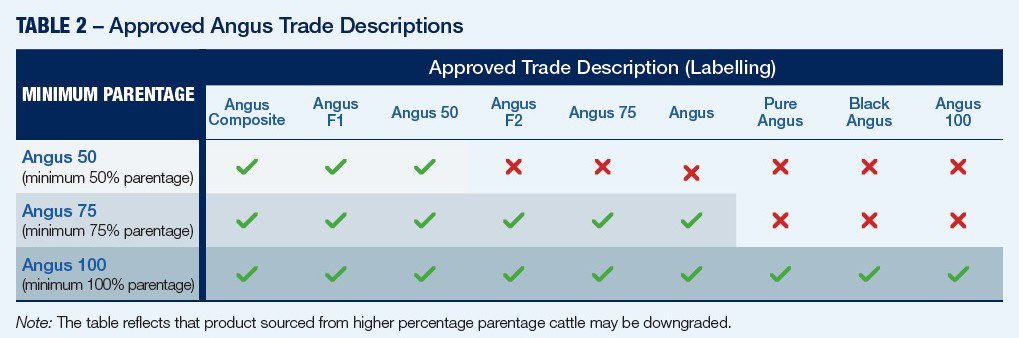
“Brands are broader than that. If somebody had a brand based on 50pc Angus called ‘John’s Angus’, that would be quite acceptable. However the trade description label on that box, it will have to use one of three terms for beef containing at least 50pc Angus genetics: Angus Composite, Angus F1, or Angus 50.
Other descriptors like Angus Composite were rejected by the committee, being deemed too ambiguous.
“The key legislation underpinning all this says all trade descriptions must be accurate, and non-ambiguous. That is the guiding light in any decisions made about trade descriptions,” Mr Robinson said.
In parallel, for an Angus 75pc brand program, from 1 July trade descriptions can include Angus F2, Angus 75 or simply ‘Angus’, to align with the programs that have operated up to now. For a purebred Angus beef program, the accepted terms include Pure Angus, Black Angus, or Angus 100.
Worth noting, meat trade descriptions cover the entire carton – not simply the carton end-panel containing product information.
- See today’s separate story on what major Angus brand program managers are doing in the lead-up to July’s AusMeat breed content changes.
HAVE YOUR SAY