
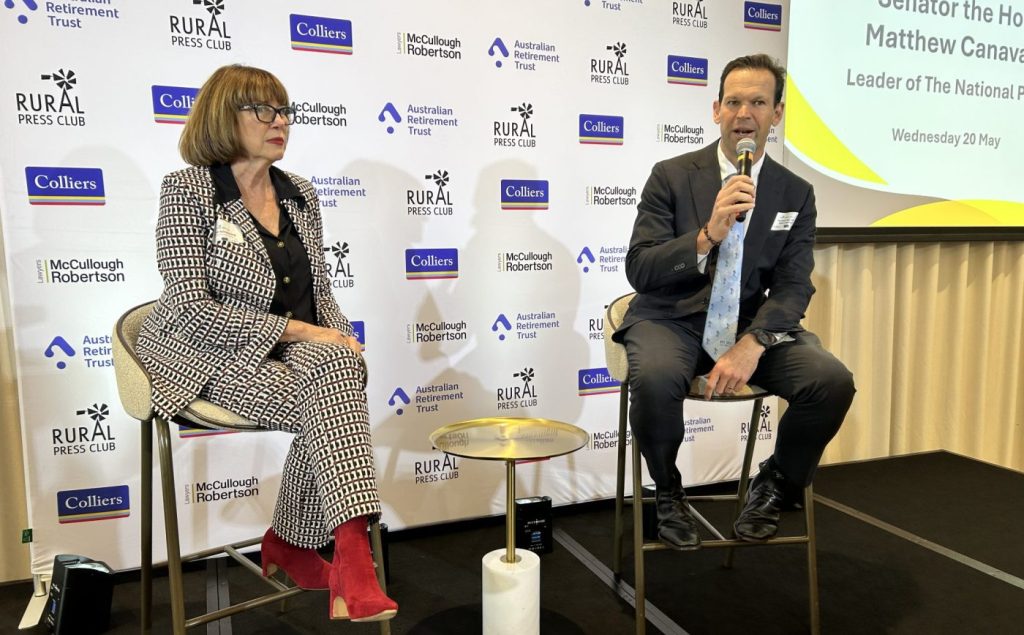
Sen Matt Canavan takes questions during yesterday’s Rural Press Club event in Brisbane, fielded by ABC’s Cathie Schnitzerling
SOME large corporate agricultural enterprises and international ag investors may be able to dodge the new tighter Capital Gains Tax rules that will unfairly burden smaller primary producers, says Nationals leader Matt Canavan.
Primary producers will be among the hardest-hit sector under Labor’s new CGT rules, and mum-and-dad farmers will suffer most, he said.
Speaking after his address to the Rural Press Club in Brisbane yesterday, Sen Canavan said: “In truth some international companies may not have to actually pay extra tax, depending on how they’re treated under international tax laws.
“So that – to me – it makes these tax changes even worse in the sense that Australian investors will definitely have to pay, but some international investors may get off scott-free.”
He added: “It’s probably the case that your large corporates will find ways to get around it; superannuation farms, some corporate vehicles won’t have to pay these extra taxes. But your average mum-and-dad, family farms, small business owners, will get hit.”
 Ten weeks into his new job leading the Nationals, Sen Canavan’s address to the 160 lunch guests in Brisbane yesterday focused on the CGT implications for agriculture, calling them ‘the biggest tax grab in Australian farming history.’
Last week’s Federal Budget flagged replacing the 50 percent CGT discount with cost-base indexation and a 30 per cent minimum tax rate. However, Sen Canavan argued that the average broadacre enterprise in Australia faced a 38pc tax rate, based on historical increases in land value.
“Returns for Australian farmers are skewed towards capital gain, not income, and so any increase in the taxation of capital gains is going to hit Australian farmers the hardest,” he said.
“In farming, you tend not to make a lot every year. It’s a pretty skinny game; the profit margins are fairly thin. You try to survive through weather, through global markets. You get by and you hope that over time the land value, the land price appreciates and you make good money through that.”
How is that going to help young Australian get into farming?
Citing ABARES data, he noted that, over the past decade, average farming land values had increased annually by 9.8pc. With a projected inflation rate of 2.5pc, that would amount to a CGT rate of 38pc after a decade under Labor’s proposals.
“This is something the government has admitted. This would be the biggest tax grab launched on Australian farming in history, to go from a 23pc tax rate to 38pc overnight, without the mandate of the Australian people,” he said. “How is that going to help young Australian get into farming?”
He said that he had joined with Liberals leader Angus Taylor in seeking a Senate inquiry into the issue, adding that farmers should be included in any consultation process over the proposed changes.
As guests dined on bush-spiced chicken and lemon thyme lamb rump, the Senator tackled the issue of the recent Farrer by-election, where the long-ruling Liberals preferenced One Nation on their how-to-vote card … and One Nation ultimately took the seat.
Sen Canavan responded: “In terms of preferences I don’t want to over complicate things. While I’m the Nationals leader, Socialists and Communists will go to the bottom, it’s a simple as that.
“Some people raised the suggestions that somehow we should have done some tricky deal, where we put One Nation down: you know, not lose the seat to them. Well, we’d be effectively trying to trick with those and defraud them,” he said.
“One Nation won that seat, they won it fair and square. I’m happy to admit that and I congratulate them on that. I want to defeat Anthony Albanese and I also don’t think that One Nation is the answer. I want to win on our merits and what we do – not with some tricky deals with the Liberal Party.”
Poor trade deals
Sen Canavan’s criticism of current government policy and actions was wide-ranging, sharing his thoughts on topics from water buybacks to land clearing, carbon credits to immigration targets.
He slammed the latest trade deals: “Just made for the sake of it, not really providing value. The EU trade deal was the worst trade deal ever. Almost zero benefit to Australia, apart from giving the Europeans the right to tell us what to do.”
Then he turned to the domestic marketplace. “We need more competition in our internal markets as well,” he said. “We need to focus more on internal competition. The continuing poor behaviour of Coles and Woolworths is why the National Party remains committed to having divestiture powers in our competition laws, like almost every major economy has.
“We are one of the very few that doesn’t have such powers and we need more competition, so we will continue to push for those.”
He hinted at Nationals’ plans to attempt to revive regional Australia through population decentralisation.
“We are talking a lot about tax incentives and other things for regional areas. I think there’ll be more to come from that from the National Party.“
He concluded his address by saying: “I want see us rediscover our pioneering spirit as a nation … Why aren’t we developing northern Australia? There’s so much water, so many opportunities there. Let’s unlock that opportunity and not just lazily sit back in our big houses and not grow something new for the next generation.”