
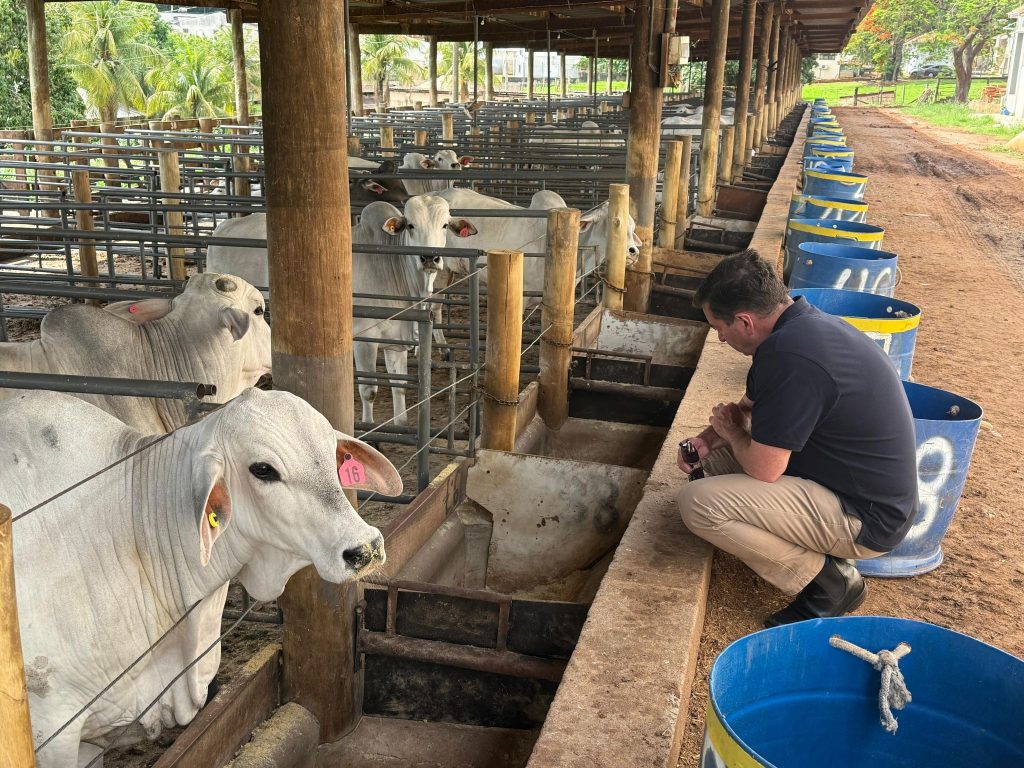
Brazilian Nelore cattle in the Rumin8 feeding trial
FEEDING trials on Nelore cattle in Brazil using methane inhibitors have produced significant emissions reduction and improved feed efficiency.
Minerva Foods, one of South America’s largest beef exporters, partnered with Australian methanogenic feed additive producer Rumin8 in a study demonstrating significant reductions in methane emissions from cattle, as well as improved feed efficiency.
The results mirror feedlot and grass trials in Australia.
The research was conducted in partnership with the University of São Paulo through the Luiz de Queiroz College of Agriculture, one of Brazil’s leading agricultural research institutions.
The 120-day study evaluated the impact of Rumin8’s manufactured bromoform (same active ingredient as asparagopsis) based feed additive on enteric methane emissions and productive performance in Nelore cattle under conditions simulating commercial Brazilian feedlot operations.
Animals receiving the additive in a total mixed ration (TMR) showed a 50.4pc reduction in methane emissions and a statistically significant 5pc improvement in feed conversion efficiency compared with cattle fed the same diet without the additive.
In a statement, Rumin8 chief executive David Messina said the collaboration represents an important step toward scaling methane-reducing technologies in one of the world’s largest cattle markets.
 “Minerva and Rumin8 are both committed to reducing methane emissions from the agriculture and food sector, and it was excellent to have this work validated by one of Brazil’s most respected academic institutions,” Mr Messina said.
“The results of this study were significant and will form part of our data package as we move toward commercialisation in Brazil, home to the world’s largest commercial cattle herd.”
The study also found that methane intensity per kilogram of liveweight gain decreased from 77.2g/kg to 39.6g/kg when comparing cattle fed only a TMR with those receiving the additive.
In total, the trial achieved an estimated reduction of 29.8 tonnes of CO₂ equivalent in greenhouse gas emissions, while also delivering productivity gains and lower feed consumption.
Independent verification of the results is currently underway by companies specialising in agricultural carbon certification, including Athian and FoodChain ID.
“This study highlights the potential of innovation and collaboration between industry, science and technology to address one of the most pressing challenges on the livestock sector’s climate agenda,” a Minerva Foods spokesperson said.
“Reducing methane emissions is a strategic priority for advancing more sustainable cattle production, and initiatives like this help accelerate solutions that combine productivity and environmental responsibility.”
280 cattle involved in trial
The experiment involved two groups of Nelore bulls. The first included 80 animals housed in individual pens to allow precise measurement of feed intake and methane emissions. These were divided into a control group receiving only a total mixed ration and a group receiving the diet supplemented with the additive.
A second group of 200 bulls was fed the additive in collective pens to simulate commercial-scale operational conditions.
Throughout the study period, cattle were fed a typical Brazilian feedlot finishing diet consisting of 12pc roughage and 88pc concentrate, with ground corn as the primary ingredient. Feed intake was monitored daily and productive performance was assessed through liveweight measurements during the trial.
According to the researchers involved, the results position the tested additive among the most promising methane mitigation strategies evaluated by the institution, with potential to reduce the environmental footprint of beef production while improving production efficiency.
The statement said the initiative reinforced Minerva’s commitment to advancing innovative solutions that support the sustainable development of the livestock value chain through partnerships with technology companies and leading research institutions.
With operations in Brazil, Paraguay, Argentina, Uruguay, Colombia, Chile and Australia, Minerva employs more than 30,000 people and operates 46 industrial facilities, 18 international offices and 23 distribution centers, supplying beef, lamb and processed products to customers across five continents.
Low methane wool launch
In separate news relating to livestock methane-inhibiting products this week, a low-emissions wool product has been launched in New York.
The wool, produced using sheep fed a ration containing Sea Forest’s SeaFeed asparagopsis-based additive came about from a partnership between apparel brand Theory’s parent company Fast Retailing and fine wool producer Congi Farm in New South Wales.
Theory will introduce the first garments made from low-carbon superfine Merino wool within its Regal Wool program this northern hemisphere spring.
The SeaFeed supplement added to the diet of sheep in the program reduced methane emissions by about 43pc, project managers said in a statement.
“The pilot represents a meaningful step forward in reducing emissions at the raw material stage of wool production, one of fashion’s most high-emission fibres,” the statement said.
For apparel brands, raw materials such as wool typically represent a significant share of Scope 3 emissions, making farm-level interventions critical to meaningful decarbonisation, it said.
Through this 120-day pilot at Congi Farm, 2000 Merino sheep were given SeaFeed delivered via salt-pressed lick blocks. SeaFeed comprised just 1pc of the sheep’s diet, yet resulted in a 43pc reduction in enteric methane emissions in accordance with ISO standards.
“It was able to mitigate approximately 54.5 tonnes of CO₂e over the trial period, equivalent to the annual greenhouse gas emissions from about 12 gasoline-powered passenger vehicles,” the report said.
Results were subject to an independent technical review by Atmosphere Alternative, providing third-party assurance of the methodology and calculations.
“Theory, in partnership with Fast Retailing, is one of the first global brands to implement this solution at scale within a luxury wool program,” Sea Forest chief executive Sam Elsom said.
“Their willingness to invest in farm-level change sets a new precedent for what responsible sourcing can look like in the fashion industry. Livestock emissions remain one of the most challenging areas of decarbonisation globally. By targeting methane at the farm level, Theory is advancing a practical, scalable solution that addresses impact before fiber even reaches the factory floor. We are proud to be supporting this pilot with them.”
“Sustainability is not solved in silo; it’s built through partnerships with stakeholders in our supply chains,” said Kazumi Yanai, Theory’s global chairman. “Because of our deep, long-term partnerships with our farm and mill, we were able to pilot an innovative solution that meaningfully reduces emissions at the source. This is exactly the kind of collaborative progress our Theory for Good platform is designed to encourage.”
Founded in 1928, Congi Farm is a fourth-generation family business based in the New England region of northern New South Wales. Covering 10,700ha, the property produces superfine Merino wool and is committed to responsible land stewardship, animal care, and the continued advancement of wool quality.
With deep roots in Australian agriculture and a longstanding relationship with family-run textile partner Botto Guiseppe, Congi Farm combines heritage, innovation, and a passion for producing exceptional wool, the statement said.
Michael Field from Congi Farm said his business was always looking for ways to improve how it cared for the land and animals while producing the highest-quality wool.
“Partnering with Theory and Sea Forest on this pilot allowed us to test a promising innovation without compromising on the quality of our wool. We’re excited by the results and proud to work alongside partners who are committed to investing in innovation at the farm level.”