
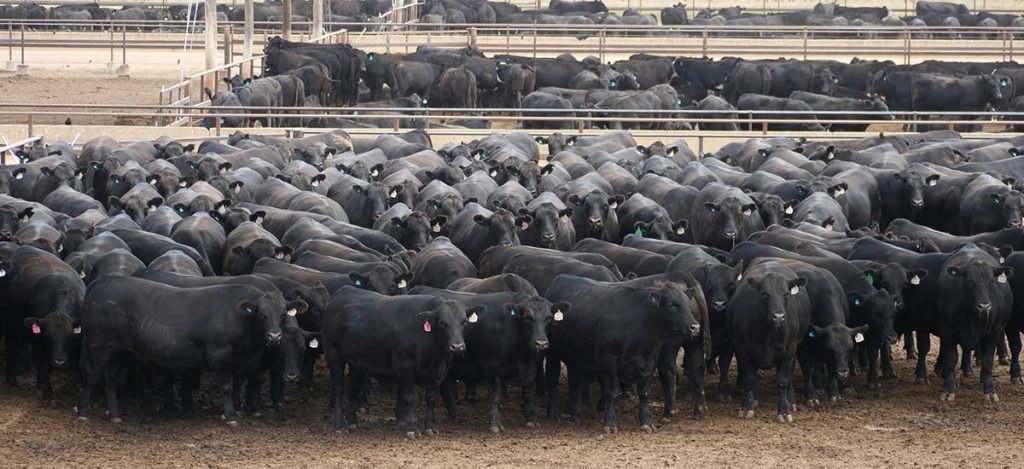
Angus cattle on feed at Teys Jindalee feedlot
WHILE the new breed description regulation announced by AusMeat today will apply to all beef breeds (and indeed other species), Angus is clearly at the forefront of the process, and the debate that’s unfolded over the past three years.
The Wagyu sector, for example, already has well-established F1 brand claims. The previous F2 minimum content level for an Angus claim in Australia was set decades ago, when the breed’s impact and (associated premium) was still much less distinct. The now-defunct industry-managed Certified Australian Angus Beef program was at the centre of that history.
For producers of Angus cattle in Australia, today’s announcement is far from universally supported, however.
Distinct price premiums are often evident in the market for Angus cattle over conventional breeds, and some fear the new regulation may dilute, or at least confuse that.
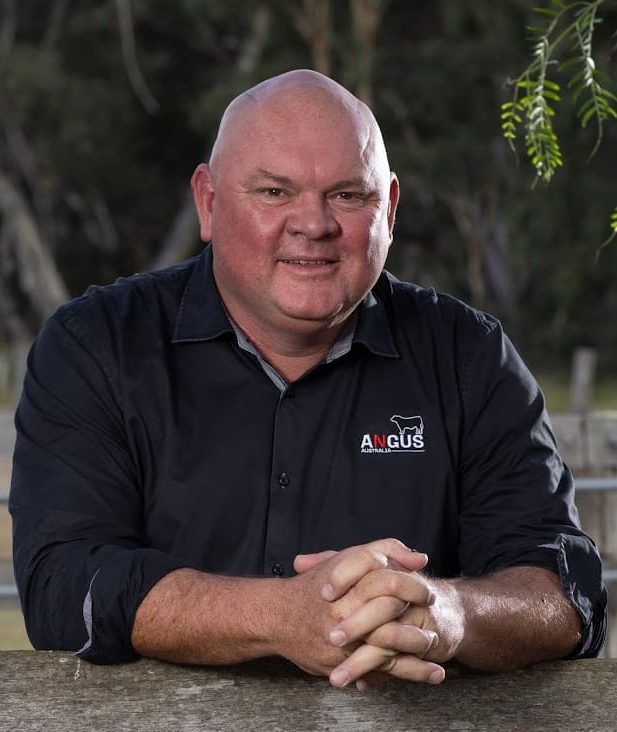
Scott Wright
Angus Australia chief executive Scott Wright told Beef Central that while the outcome delivered today appeared to be a workable solution that addressed many of the challenges raised earlier, there would be some Angus producers who did not support the changes, while others would ‘love it’.
“Those against the move have already made that very clear to me,” he said.
“They believe it represents a dilution of a very strong brand, which carries a distinct premium. And they are worried about a dilution in meat quality from the breed contributing the other 50pc,” Mr Wright said.
To explain this, under the new terms a sample of beef carrying an ‘Angus 50’ claim could in fact come from an Angus x Shorthorn steer, or an Angus x Brahman steer, and get put in the same box. Obviously some brand managers would apply other criteria such as MSA eating quality index scores to limit any downside.
Mr Wright said this concern had been raised with him by a number of Angus stakeholders.
At the same time, its important to note that the Angus breed has worked hard over recent years promoting its breed attributes to Northern Australian cattlemen and women. Most of that has been about improving meat quality (and hence MSA index), as well as fertility, rather than anything to do with ‘branded beef claims.’
But how that is now reflected in ‘Angus 50’ identified product claims going forward remain to be seen. It leaves Angus Australia in a tricky position.
“The industry is a little split on this, to be honest,” Mr Wright told Beef Central.
“Many large-scale southern Angus (purebred) feeder steer producers feel that they have invested, for many years, in targeting a quality product, and that this may dilute that. Their thinking is that if you are putting a breed claim on a box, then it needs to be higher content than 50pc,” he said.
“However, at the same time, we have other members who are quite pleased with the outcome. There is certainly a diversity of views within the Angus breed on today’s outcome – from very positive, to very disappointed.”
“Those in support see the result as potentially creating more value for cattle with a 50pc component of Angus genetics, that did not previously exist – including areas like beef trimmings, where big customers like McDonald’s run successful Angus premium burger programs.”
 “They can see that the US market has had a 50pc Angus content benchmark for decades, and they can see the positive opportunity in that. In effect, the US Certified Angus Beef program has determined the market specs for the world industry, for a very long time.”
“But on balance, AusMeat’s Language Committee has done a good job of framing a model that is workable, under difficult circumstances,” Mr Wright said.
Asked whether there was an expectation that the Angus breed could sell more bulls on the strength of the announcement, he thought not.
“I’m not hearing that. Our penetration has already been good. If there is a positive, it could be for those Queensland producers with an F1 product, that did not exist previously. The opportunity for F1 Angus x dairy beef is much less – the dairy industry is yet to really embrace the beef on dairy principle.”
Separate price premiums?
Beef Central asked whether separate, distinct price premiums might now emerge for different percentage Angus feeder and slaughter cattle.
Angus Australia survey work last year identified a 15pc premium for second-cross and higher Angus cattle. For first-cross cattle, a 6pc premium was identified, across a yearly cycle.
“We think there’s a little signal there that meat quality – as distinct from a brand claim on an F1 animal – is useful to the processors,” Mr Wright said.
“Whether that changes now under the Angus 50 program, remains to be seen.”
Asked whether the ‘full’ Angus premium could now get diluted, Mr Wright said AA would watch livestock market developments with ‘real interest.’
“In fact we might see a the opposite – strengthening of the higher content brands, covering 75pc and 100pc cattle,” he said.
DNA verification
Another important component in the new Angus branded breed claim space is progress in DNA-based breed content verification development.
Angus Australia is working with two large processors in trial work in this area, likely to be fully commercialised some time this year.
Once that happens, it will help strengthen claims when customers want higher-content Angus to underpin product quality and consistency. It should eliminate any risk of F1 cattle being shandied into higher content boxes.
Angus Australia already has in-principle agreement from two large processors to implement the DNA testing process.
What impact does this change have upon producers of Angus cattle?
AusMeat says for producers, the identification and recording of accurate breed descriptions continues to be an essential aspect of completing the Livestock Production Assurance National Vendor Declaration.
“The introduction of the Angus 50 program has emphasised the additional need to clearly record differences in parentage (as applicable) to ensure eligibility for supply into branded beef programs, and in turn, maximise the value proposition of beef from the farm gate and throughout the supply chain,” AusMeat told stakeholders this week.
“In the case of Angus, this can readily be achieved by using the descriptions of Angus 50 or Angus F1; Angus 75 or Angus F2; Angus 100 or Angus Purebred.”
“Ensuring cattle descriptions are accurate is essential for regulatory compliance, market access and to support the continued strength of Angus-branded programs in both domestic and international markets,” AusMeat advised stakeholders.
Several export beef processors spoken to following today’s announcement said they expected different meat price points would now emerge for cartons carrying 50pc, and 75pc and higher Angus claims.
Feedlot sector response
The lotfeeding and processing sectors and their close connection with quality beef brand programs have been at the core of concerns over the advent of 50pc breed content claims.

ALFA chief executive Christian Mulders
“As hard as all this has been, the great outcome here is that we now have a really robust framework for supply chains to raise breed claims,” the Australian Lot Feeders Association’s chief executive Christian Mulders said.
“That’s fantastic. It’s about the integrity of the claim, and having an agreed system to be able to do that, with a level of integrity.
“In the case of the Angus breed example, specifically, brand managers are now able to raise claims, and there’s going to be integrity within that agreed framework – whether that be 50pc, 75pc or whatever,” he said.
“It was really important that those existing 100pc and 75pc programs did not change, and ALFA was steadfast about that. Obviously the level of investment that’s been made over many years by the program managers, and the brand equity involved was important. So that’s a really good outcome.”
‘But we now also have a system to raise a 50pc claim, and that is clearly articulated in the language, and can be differentiated. That’s also a good outcome.”
“It’s taken the best part of three years and a lot of time and effort across the industry to get there, but that journey has resulted in a robust program. It’s a really good outcome for industry.”
The Australian meat Industry Council, representing processors and exporters, provided a statement on request, saying the changes reflected greater alignment between Australian and US Angus standards, expanding opportunities for Australian beef brands.
“This update is the culmination of several years’ work between peak industry bodies and AusMeat and provides greater clarity in use of breed raising claims,” AMIC chief executive Tim Ryan said.
Click here to return to main story announcing the new Angus 50 description framework.