

IT IS not uncommon for some producers to overestimate the ongoing performance gained from a bull purchase decision made years previously.
It is true that genetics offers permanent and cumulative improvements to a beef herd, however it is also important to remember that genetic improvement is not a one-off.
4WD analogy
An easy way to consider the impact of genetic improvement could be to compare herd progress towards a breeding goal in the same way we might consider comparing the performance of two generations of Toyota HiLux – the first being the current 2026 series, while the second is a 2006 model.
Both vehicles are made by the same manufacturer and are ostensibly very similar in what they offer. However, there are some dramatic differences in performance.
 As an illustration, driving from my home to Tamworth and back in my HiLux is a round trip of 1192km. My operating environment is the road network with its speed restrictions, the risk of hitting a roo and the cost of diesel. In a current model HiLux, that round trip would take around 13hours (averaging 91km/hour). And in fuel cost it would be about $188.
Comparing this to a 2006 model HiLux, the trip would take an hour and half longer (averaging 83 /km hour) and the fuel cost would be $299 or $42 more than the newer model.
On the face of it, some people may argue that this isn’t too great a difference, and in the scheme of things acceptable. The goal of traveling to Tamworth and back has been achieved, and while it may have been a little longer and cost a little more, it’s not a huge cost.
Accumulated cost
However, if that was a journey made once a week (or 52 times a year) it’s a very different story. At the end of 52 round trips, the current model vehicle would have clocked up 681 hours driving, used 5580 litres of diesel for a total fuel cost of $9765. The 2006 HiLux would have taken 751 driving hours, using 6817 litres of diesel and cost $11,930 in fuel.
In real terms, the difference between the two is 70 hours of driving (3 days difference); 1237 litres of diesel and a costs difference of $2165.
So while it is possible to say that both the current model and the much earlier model did achieve a set goal, the cost and resources used by the older model, as well as the time associated with achieving this goal is clearly inefficient.
Herd inefficiency
This is the case with many beef herds across the country. There are herds that invested in superior genetics some years ago, using the leading sires at the time. However, those genetics are now surpassed by the current generation.
This is very clear for most breeds, with perhaps the most striking example presented by Dr David Johnson at last year’s Northern Genetics Field Day held at Spyglass Research Station near Charters Towers in North Queensland.
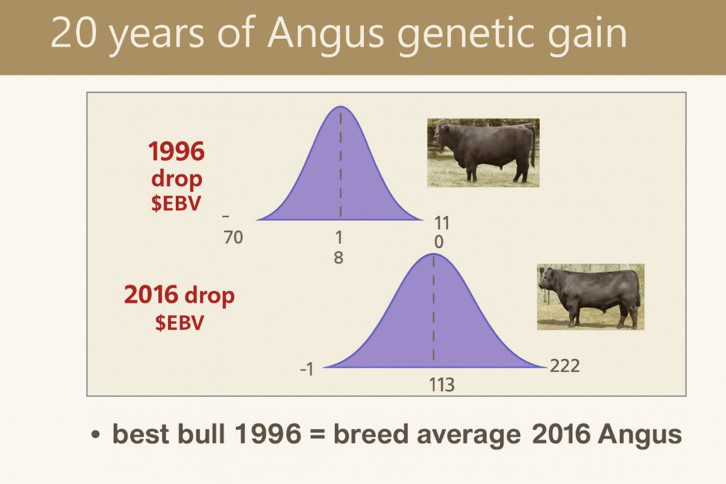
During his presentation, Dr Johnson highlighted the huge progress that the Angus breed has made over the past 20 years.
The slide below shows that the average Angus born in 2016 had a similar $EBV performance to what had been the Top 1pc of the breed in 1996. This shift is often underestimated, particularly because of the incremental shits that occur through genetic improvement.
Source: Dr Davide Johnson AGBU
Small gains are cumulative. In practice this means that producers who focus on and record performance, continue to use sires with high accuracy genetic information, and place high selection pressure on their replacements do move their herds towards more productive and profitable outcomes.
It is just as important to recognise that genetic progress is not limited to growth and days to turnoff, although these remain highly visible and commercially significant drivers.
In the same way that newer vehicles have not just become faster but also incorporate features that make travel easier, safer and more efficient, modern cattle genetics now include information on traits that were either poorly described or largely unavailable two decades ago.
In the same way that newer vehicles have not just become faster but also incorporate features that make travel easier, safer and more efficient, modern cattle genetics now include information on traits that were either poorly described or largely unavailable two decades ago.
Today, bull breeders and commercial beef producers have access to selection tools around eating quality, feed efficiency, structural soundness, temperament and maternal performance. These traits influence not just how quickly cattle reach market, but how consistently they meet market specifications and how efficiently they are managed along the way.
Like the example used around the Tamworth road journey, in breeding no single genetic trait accounts for the entire difference that can be measured. It is the cumulative effect of marginal gains across multiple performance areas that ultimately determines enterprise efficiency, cost of production and market compliance.
Herds relying heavily on sires that are representative of past genetic benchmarks may still reach their production goals, just as the older HiLux still reaches Tamworth, but they do so using more time, more feed and at a greater cost per kilogram produced. The commercial challenge is not whether older genetics still function, but what it costs to keep operating behind the performance level now available.

Alastair Rayner
Alastair Rayner is Principal of RaynerAg. He has over 28 years’ experience advising beef producers and graziers across Australia. Alastair can be contacted here or through his website: www.raynerag.com.au