
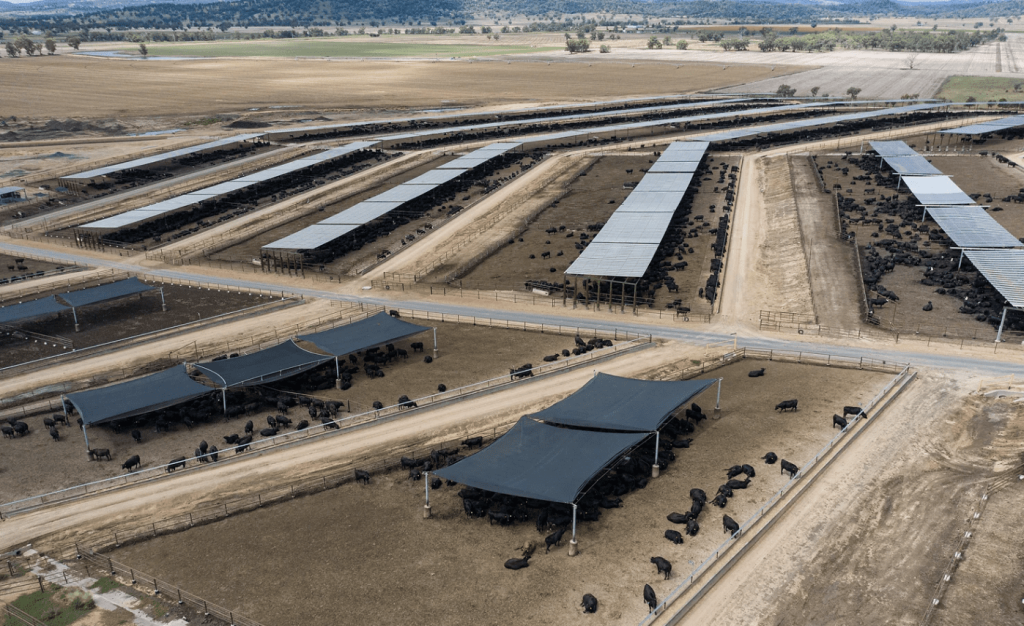
AUSTRALIAN lotfeeders have embraced the welfare and productivity benefits of shade – demonstrating their commitment through significant commercial investment to reach 75.1 percent of feedlot cattle capacity now being managed under shade.
A report released by the Australian Lot Feeders Association – ‘ALFA’s Shade Initiative – Our Journey Towards Having All Feedlot Cattle with Access to Shade’, highlights strong industry-wide progress towards shade adoption since 2020 when the initiative was first launched.
ALFA’s Shade Initiative seeks to advance animal welfare, production efficiency, and long-term sustainability by encouraging shade and covered housing infrastructure adoption within Australian feedlots.
In 2018, the grainfed beef industry set an objective, asking all members to make a pledge to provide cattle under their care with access to shade by 2026.
“Shade access across National Feedlot Accreditation Scheme feedlot constructed capacity has increased from 56.3pc in 2020 to 75.1pc today – more than 1.32 million cattle in feedlots have access to shade,” ALFA president Grant Garey said.
“An additional 518,305 cattle are now housed in shaded pens at any one time when compared with 2020 when ALFA launched the Shade Initiative. Accounting for multiple turns per year, this represents that 2,584,861 cattle have benefited from new shade installations over the past five years,” he said.
This steady growth is particularly notable given the significant construction and supply chain disruptions experienced during the pandemic period, including material shortages, rising building costs and labour constraints, and the simultaneous expansion of total national feedlot capacity.
“Shade installation is voluntary, yet adoption continues to grow annually, despite rising construction costs. Our journey to date reflects feedlot operators’ commitment to, and confidence in the welfare benefits and productivity gains associated with shade provision,” Mr Garey said.
“Shade enables cattle to express natural behaviour through thermo-regulation, improves comfort, and reduces the risk of heat-related impacts in relevant climates.
“Australian feedlot operators have embraced these welfare benefits, supporting the industry’s commitment to the Five Domains model and continual improvement in animal welfare,” he said.
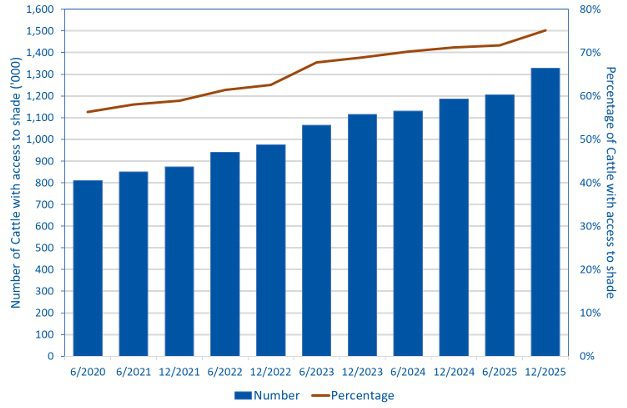
Number of cattle with access to shade and percentage of constructed capacity from June 2020 to
December 2025.
Feedlot productivity gains
The initiative has also delivered significant productivity gains.
“The 518,305 cattle provided with shade in 2025 are projected to gain 6,147 tonnes of liveweight or 3,213 tonnes of grain fed carcass weight over the 2025/26 summer, equating to around $28.1m in additional returns to Australian lot feeders,” Mr Garey said.
“The cumulative impact of 2.584 million cattle with access to shade from 2020 has been estimated at an additional return of $67.67 million to Australian lotfeeders.”
Led by ALFA and supported by Meat & Livestock Australia using grain fed levies matched by Australian Government investment, the initiative has accelerated commercial adoption and investment across a diverse range of feedlot operations and climatic regions.
MLA, in partnership with ALFA, has invested $3.574m in shade research since 2008, with a further $2.471m currently invested in ongoing research, aimed at advancing our scientific knowledge of shade benefits for cattle welfare and productivity.
“Looking ahead, feedlot operators surveyed plan to continue investing in shade and shelter infrastructure, with cattle under shade estimated to rise to about 83.5pc of total constructed capacity by the end of 2026 and 85pc by 2029,” Mr Garey said.
“ALFA’s Shade Initiative has been a major undertaking for the Association and the feedlot industry. The growth in shade infrastructure signals our sector’s commitment to welfare, productivity, drive for continuous improvement, and a long-term sustainable future.”
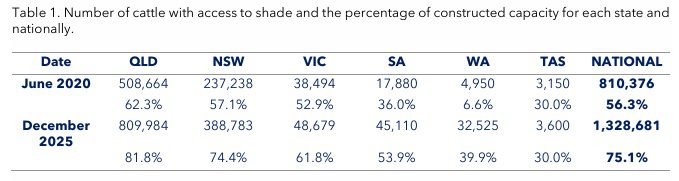
Number of cattle with access to shade and the percentage of constructed capacity for each state and nationally.
Growing industry interest in permanent shedding systems
Across the initiative, there has been clear growth in operator interest in partly and fully-covered permanent housing systems (essentially, waterproof permanent shedding or waterproof fabric).
Survey results showed that as of December 2025, there were 48,000 head in fully-covered pens and 35,000 head in partially covered pens, consisting of either iron roof or waterproof fabric, or a total of 83,000 head. Waterproof structures are considered a type of shade, and are included in the total number of head shaded in ‘ALFA’s Shade Initiative – Our Journey Towards Having All Feedlot Cattle with Access to Shade’ ALFA’s Shade Initiative – Our journey towards having all cattle with access to shade report.
This has been driven by:
- The unique climatic conditions experienced across areas where feedlots are located.
- Need to manage extreme weather events, with a particular focus on high rainfall zones, winter conditions and prolonged wet weather events, and to reduce heat load impacts.
- Improved control over effluent and water management within intensive production environments.
- Opportunities to integrate renewable energy or waste-to-value systems (e.g. solar, biogas).
While initial capital investment is higher, operators increasingly recognise the potential for productivity gains, operational efficiency, and market differentiation through covered housing infrastructure in certain climatic areas.
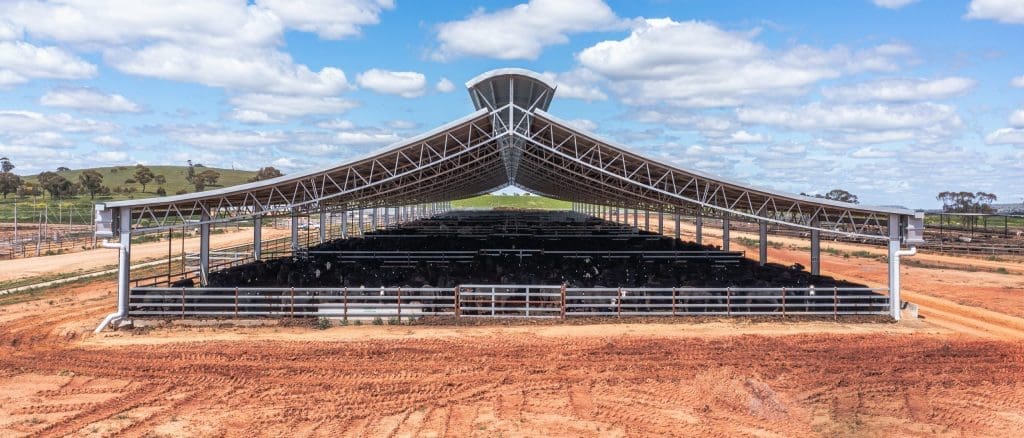
Permanent Ridgeback shedding installation in Teys Australia’s Charlton feedlot
Challenges and opportunities
The adoption of shade infrastructure in Australian feedlots presents a significant opportunity to enhance animal welfare, productivity, and heat-stress and climatic resilience across the sector.
However, these benefits must be weighed against practical challenges such as capital cost, design complexity, and the need for evidence-based guidance tailored to diverse feedlot environments and climatic conditions.
Challenges
- Capital investment and financial feasibility remain major barriers, particularly for
small and medium-sized feedlots where return on investment may be uncertain -High capital costs, increased building and material prices following COVID-19, limited contractor availability, and long construction lead times continue to impact feedlots’ ability to commit to shade infrastructure. Following the initial shock of the COVID-19 pandemic, the Australian Bureau of Statistics (ABS) reported that “prices received by building construction businesses have increased 31.1pc from September quarter 2020 to June quarter 2024, driven by growth in house construction prices which rose 40.8pc over this period. Prices received for other residential building construction (25.3pc) and non-residential building construction (27.1pc) also strongly contributed to the rise.” - Designing and constructing effective shade or covered housing systems is complex and often requires region-specific, custom-engineered solutions – Feedlots face challenges associated with environmental and planning approvals, engineering requirements, and can lead to increased pen maintenance costs under shade, highlighting the need for clearer guidance and more consistent approval pathways.
- Industry attitudes toward shade vary significantly, creating inconsistency in
adoption across regions and feedlot types – Some operators believe Bos indicus and Bos indicus-infused cattle or cattle in temperate climates do not require shade, while others rely on past experience of cattle management and observation as justification for not investing in infrastructure. - Confusion exists within parts of the industry about whether shade should be
compulsory, leading to mixed perceptions of the initiative – Whilst most feedlots
support the implementation of shade, some have misinterpreted elements of the initiative as a regulatory requirement, underscoring the need to ensure that communication is clear and consistent. This will continue to be important as focus increases on ensuring that feedlots understand the welfare and productivity benefits that it is a commercial decision regarding implementation of shade and covered housing systems.
Opportunities
- Strong productivity and economic benefits continue to drive interest in shade
adoption across the feedlot sector – Demonstrated improvements in average daily gain, feed efficiency, and carcass quality make shade one of the most compelling welfare investments from a commercial performance standpoint. - The growing consideration of covered and semi-covered housing systems reflects a shift toward greater climate resilience and improved operational management – These structures not only support animal comfort but also offer advantages during wet weather, enabling better pen-surface control and potentially supporting higher stocking densities.
- Shade and shelter infrastructure is increasingly recognised as a key component of broader sustainability and emissions-reduction strategies – Integration with frameworks such as industry sustainability metrics creates opportunities to link animal welfare with environmental outcomes, strengthening industry credentials.
- There is significant scope to accelerate adoption through co-funding, incentives, and tailored design approaches suited to individual site conditions – With options ranging from shade cloth and iron sheeting to waterproof fabrics and fully roofed systems, combined with potential industry and government support, feedlots can select solutions that align with their operational needs and strategic goals.
Beef Central asked whether the industry move to longer average days on feed, and the growth seen in longfed Wagyu was exposing the industry to greater summer heat load risk, and whether this was a driver of recent shade installation.
“Climatic conditions/factors have the most significant influence on heat load risk,” an ALFA source said.
“It is ALFA’s experience that longfed Wagyu cattle are not affected any more than any other breed.”
ALFA said there were nil reportable heat load incidents across Australia last summer (mortalities above a certain level after heat load events must be reported under NFAS regulation), but was unable to draw any conclusions about the contribution that greater use of shade was making to that result.
Source: ALFA